About The Heavy Metal Foundry

Focusing on acts from 1965 right through the 80's, the Foundry features a vast pantheon of bands that gave form and definition to that sound we all lovingly call Heavy fuckin' Metal.

We intend to promote awareness of forgotten artists and reigning legends by reviewing classics of the genre thereby tracing the origins of Heavy Metal.

\Stay Heavy/

Showing posts with label Thrash Metal. Show all posts

Saturday, August 27, 2011

Death Magnetic (2008)


Phoenixes are mysterious creatures. Legend has it that the mythical bird used to, at the end of its life time, consume itself in flames and take birth again from the very same ashes.

In many ways Metallica’s last few years mirror the life of a phoenix. After S&M it was as if nothing could go wrong. Seven studio albums, a live one, millions of records sold, stability in the band and a rapidly growing fan base – the phoenix was flying high in the sky.

Then came the first signs of the end. The rift between front-man Hetfield and bassist Newstead widened with the latter eventually quitting the band. Lars decided that he’d take the short-cut to being the most hated person in the music industry and got himself embroiled in a law suit against Napster – the free music sharing system thus alienating a huge number of fans. To top it all Hetfield’s drinking problem snowballed to such an extent that he had to join rehab thereby throwing the band’s future into darkness.

The all consuming fire then culminated with their next album – St.Anger. This album was Metallica’s marmite – you either hate it or you love it. But both consenters and dissenters agreed on one truth-Metallica had combusted to ashes in a blaze.

A new producer, a new bassist and a new mindset – the rebirth of the Metallica-Phoenix began. Every phoenix needs a song and Metallica’s was called Death Magnetic. It is only apt that they chose to sing about one of the few constants in everybody’s life – death and this forms the Sun in the Death Magnetic-Solar system with each song revolving around this central idea.

1. That Was Just Your Life begins with the new born phoenix’s heartbeat. Coiling around heart are clean guitar riffs followed slowly by the bass and Lars’ cymbals. Slowly setting into a new rhythm, Hetfield takes over, with his (new) aged but powerful voice, ably supported by Trujillo and Lars. As the trio slowly set into a fast and heavy chorus, Hammett drops in with his wah and trademark electric solo. The song starts gathering momentum and ends with an explosive finish.
2
. The End of the Line is the second song of the album. Much more direct when compared to its predecessor, this song immediately sets into a basic fast-paced riff (Hetfield, Lars and Trujillo combining) which persists throughout the song. Hetfield enters early and in many ways it seems like an extension of the previous song. After about 4 minutes is where the song gains its identity. A fast solo and some furious drumming later the song comes down to a slow rhythm. At the end of which both Hetfield and Lars pick up the pace- as if competing with each other in a 100 m dash before the song finally ends with Hetfield screaming out the chorus line.
3.
Broken, Beat and Scarred is up next. The third and my favourite song of the album. The brilliance of this song lies in its pacing. It resembles a smooth sigmoid curve with the introduction representing a slow trench. As is a characteristic of the album, the basic riff is introduced here with Hetfield really twisting his fingers around the strings. And as the chorus begins, the song picks up pace with the chorus line representing the fast and loud peak. Around 4 minutes is where the song changes abruptly. A new riff, new drumming pattern and faster rhythms pave the way for Hammett to blow open the roofs with his solo and James following up with a new riff signalling the climax. At this point the chorus goes into a new dimension with interference of the trenches and peaks – almost like a microcosm of the entire song- to end on a high.
4.
Coming in at number four, The Day that Never Comes is a throwback to the old times - the song opens with a slow, melancholic tune by Hetfield with Lars joining in gradually. The song continues at an amiable pace until the 4 minute mark. This is the part where the song gets interesting- a gradual pick up in pace which contains the final vocals of the song. After 5 mins is where you actually see the resurrection of Metallica. What follows is a 2 and a half minute mesh of frenetic guitars, fast drumming, Hammett’s solos and not to mention Trujillo’s excellent bass.
5.
Mythology has it that the song of a phoenix is hauntingly beautiful. Coming to think of it, that is the best way to describe All Nightmare Long also. Metallica have always had a fascination towards H.P. Lovecraft as is evident from songs such as The Call of the Ktulhu and The Thing that Should Not Be. With James singing about macabre beasts and creatures from the darker parts of one’s imagination in his gnarling voice and twisting his fingers around a spine-tingling riff ably supported by the heavy bass of Trujillo and the ever-dependable Lars- this song basically screams of Lovecraft. Hammett uses his wah admirably in generating solos which leave one with the chills.
6.
Metallica are generally known for their vivid but abstract lyrics as can be heard in their popular songs of the 90s such as Ronnie , Until it sleeps etc. Coming in at 6, Cyanide continues the tradition. The relatively slower riffs and the considerably relaxed pace of this song are probably what will catch your attention initially, but the real stand-out quality about this song is the lyrics. With lines such as
“ Say, is that rain or are they tears?
That stained your concrete face for years..”
and
“An air of freshly broken ground
A concrete angel lit right down
Upon the grave which swallows fast ..”
which blend with the curvy and twisty rhythms. This song is an excellent vocal treat where the riffs fit like a dress on a particularly gifted woman catching every curve and turn on her body precisely and enhancing them.

At seven we have a sequel. This song drags us into one of Metallica’s fortes – human emotion and particularly - regret. If Unforgiven I was about an old man, Unforgiven II about a lost lover, Unforgiven III is about a sailor. The song describes the painful story of a sailor’s temptation, his weakness and his overwhelming guilt. Starting off with a piano sequence, moving into a clean guitar riff and then the gradually increasing guitar distortion the music seems to directly reflect on the various emotions of the sailor from ambition to temptation to regret.
8.
"To me, the thing that is worse than death is betrayal. You see, I could conceive death, but I could not conceive betrayal."
— Malcolm X
Transcendence is something which seems to fascinate Metallica. The Judas Kiss takes a slight break from the literal meaning of the album and dwells in the metaphorical shadow. This song seems to be made to celebrate the death of the small part of humanity during betrayal, to celebrate the death of trust, to celebrate the yin without which there would be no yang. The mood is quickly set by start-stop guitar plays which seem to collide, coalesce and amalgamate to finally give rise to an evil riff and chorus. Another key feature that does not escape notice is how much James’ voice has changed over the years. This song particularly accentuates the fact. Similar to the other songs Hammett’s wah embellished solos leave an indelible mark on the listeners.
9.
Number nine and a long lost memory returns. This is something we’re hearing after nearly a decade – a Metallica instrumental. Suicide and Redemption is part of a lineage which includes legendary songs such as Call of the Ktulhu, Orion etc. and just like its predecessors it doesn’t fail to disappoint. If the latter two start with clean guitar riffs, Suicide & Redemption starts with a heavy bass line and a lot of distortion for the nearly the first 4 mins. After that is when a clean guitar piece slips in followed by Hammett’s solos. However the stand-out for me in this song is Lars. If the guitars take you through the meandering path from suicide to redemption, it’s the drums which act as the compass. Alternating between slow and fast, complex to simple and throwing in some delightful double-beats too, this song is all Lars for me.
1
Finally at 10, Metallica end the album on a high with My Apocalypse - a high fuelled by raw anger and undiluted energy . A riff that rushes past you at break-neck speed, drumming which is right on its tail, vivid and searing lyrics- these are what characterizes this song.

Overview :
‘Change your opinions, keep to your principles; change your leaves, keep intact your roots.’ Victor Hugo
That is exactly what Metallica have done - returned to their roots. They gained their identity with thrash metal and it is only right that they regain their identity with the same thrash. Yes, it is not the pristine thrash of the 80s but the same elements are there – fast riffs, Hammett’s solos, the instrumental , strong bass lines and the energetic drumming. If anything, it has evolved. An evolution which has strengthened the faith of the fans, regained the trust of old ones and bought the attention of the new fans. Metallica are back- and how.

Genre : Thrash Metal, Groove Metal

Track Listing :

All lyrics written by James Hetfield, all music composed by Hetfield, Lars Ulrich, Kirk Hammett, Robert Trujillo.

"That Was Just Your Life" – 7:08
"The End of the Line" – 7:53
"Broken, Beat & Scarred" – 6:25
"The Day That Never Comes" – 7:57
"All Nightmare Long" – 7:57
"Cyanide" – 6:40
"The Unforgiven III" – 7:47
"The Judas Kiss" – 8:03
"Suicide & Redemption" (Instrumental) – 10:00
"My Apocalypse" – 5:06
Total Album time :- 74:48

Total Album Time : 74:48

Personnel :
  • James Hetfield – vocals, rhythm guitar, lead guitar

  • Kirk Hammett – lead guitar, rhythm guitar, backing vocals

  • Robert Trujillo – bass, backing vocals

  • Lars Ulrich – drums


Additional musicians
  • David Campbell - orchestration on "The Unforgiven III"


Release Date : September 12, 2008

Recorded : April 2007–May 2008 at Sound City Studios, Van Nuys, Los Angeles, California; Shangri La Studios, Malibu, California; HQ, San Rafael, California

Supporting Tour : World Magnetic Tour
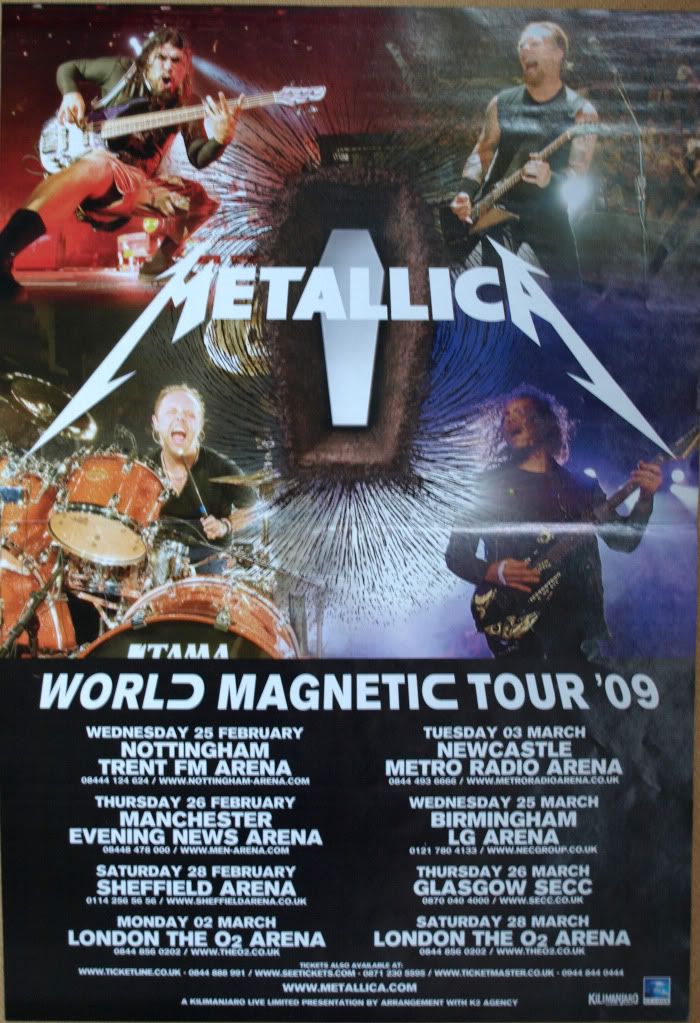
Metallica World Magnetic Tour Poster

Trivia :


Friday, June 10, 2011

Kairos (2011)


      Sepultura are back with their twelfth studio album - Kairos (Greek for the most opportune moment), which seems to be a concept albums of sorts. Musically they take the back-to-basics approach, returning to their straightforward, crushing and unrelenting Thrash of Beneath the Remains. Sure Kairos manages to bludgeon everything in it's path and what not, but does so sort of weakly. What I must concede is that it's definitely a step in the right direction, it still has the Sepultura DNA in it.

    Thematically the album is based on the concept of "Kairos" or the most opportune moment and deals with time and transcendentalism. Four of the tracks, each lasting for about thirty seconds or so are dates and the significance of each of those dates is as follows - 2011 is  Gregorian calendar year we live in, 1433 is current year in the Islamic calendar, 5772  being the current year of the Hebrew calendar and finally 4648 having the same significance in the Chinese calendar.   

     The album sounds very dark, raw and stripped down. The seething anger pulsating in riff after riff is evident from the very first track. Furious drumming, thundering basslines, guttural vocals, violent riffage and stabbing solos all enforce the downright brutality of the album, it seems like the album will explode at any point, but rather unfortunately never does, which is something you really expect given Roy Z is producing the album of one of the most energetic and bombastic bands. Green's pagan chants/yelps on quite a few tracks seem like a kickback to the Sepultura of yore, but if you're expecting the primal slogans and tribal beats from back in the day then forget it, it is but a thing of the past. Kisser after a long time feels unchained and unshackled and its there to show in virtually every solo. All the songs sound very similar which makes the album very monotonous to listen to. 

    Kairos begins its onslaught with Spectrum, some very traditional Thrash/Death that takes it's roots from Chaos A.D. As with most songs in this album, Kisser's solos are the saving grace, beyond which the song doesn't have too much to offer.

    Spectrum is followed by the title track, one of the better tracks on this album. It has that very evil, Slayer-vibe to it that will instantly hook the listener in. No nonsense Thrash, bestial vocals and a battering rhythm section, what the fuck else can you ask for? 

    Continuing in the vein of Kairos is Relentless an enraged, wrathful, nut-wrenching track championed by the aggressive basslines of Paolo Jr. 

    The fourth track 2011 is the conceptual part of the album, with random noises and sounds being played. The same goes for 1433 and 5722.

    At position five is the cover of Ministry's Just One Fix. Works very well surprisingly, impressive cover the way it works it's way around the Industrial elements.

    In at six and seven are Dialog and Mask, the fillers. Nothing particularly interesting barring a couple of bridge sections.

    Seethe, the ninth track, feels a lot like an old school Death Metal song. Exceptional stuff really, feels wasted on this album.

   Born Strong is a blistering, relentless violent Thrash attack that packs a lot of shitload of aggression and power. Amongst the gems of the album.

    Embrace the Storm is a welcome break from all the speed and fury of the previous tracks. Some mid-tempo Thrash with technical leanings and a masterful solo elevate it. The vocals however don't work on this track.

   No One Will Stand is yet again filler material, but the Andreas Kisser's middle-eastern-tinged soloing works wonders on the songs. Goes back and forth from straightforward Death to raw Thrash. Kisser does a stellar job on his part.

   Structure Violence (Azzes) the penultimate track (in the deluxe edition, or the last track otherwise) is a throwback to the Groove Metal days, with tribal drumming, Brazilian chants and the works. Slow, chugging riffs and rhythm surprisingly do well in an album that fields some fast and fiery tracks.

Overview : Kairos is not the top notch stuff that we have come to expect but a sub-par Sepultura, a slowly redeeming one nonetheless. This certainly isn't the best that Sepultura can offer though the return to roots principle is gladly welcomed. Although credit must be given to the band for continuing to experiment with their sound as opposed to producing watered down Metal to appease and bring back to the fold the "It-isn't-Sepultura-without-the-Cavaleras" bunch. 

Genre : Thrash Metal, Death Metal

Track Listing : 

Title
Writer(s)
Length
1."Spectrum" 
Sepultura
4:03
2."Kairos"
Sepultura
3:37
3."Relentless"
Sepultura
3:36
4."2011"
Sepultura
0:30
5."Just One Fix (Ministry Cover)"
Sepultura
3:33
6."Dialog"
Sepultura
4:57
7."Mask"
Sepultura
4:31
8."1433"

9."Seethe"

10."Born Strong"

11."Embrace the Storm"

12."5772"

13."No One Will Stand"

14. "Structure Violence (Azzes)"

15. "4648"
Sepultura

Sepultura

Sepultura

Sepultura

Sepultura

Sepultura

Sepultura


Sepultura
0:31

2:27

4:40

3:32

0:29

3:17

5:39


0:29

Total Album Time : 45:51

Personnel/Contributors : 
  • Derrick Green  - Lead Vocals
  • Andreas Kisser - Lead Guitars
  • Paula Jr. - Bass
  • Jean Dolabella - Drums
  • Roy Z - Production
  • Eric Sayers - Cover Art
Release Date : 24 June 2011

Recorded : December 2010 - March 2011, Trama Studios, Sao Paulo, Brazil

Supporting Tour : Kairos World Tour


Sunday, May 29, 2011

Ride the Lightning (1984)


Making its journey through thrash, Metallica follow their brilliant first album Kill 'em All with another masterful entry to the timeline of Thrash Metal, Ride the Lightning. So the Metallica logo proselytizes from a blood clad musical marauder to an electrifying blue with lightning streaks and an electric chair to add to the vibe (A similar cover, although in green, was printed. But that being a mistake, was revoked, and those became limited editions of the album). A definitive transition from the initial debut album is evident with as much as a glance of the cover art. The album speaks of the essence of Thrash Metal with songs with a pace of the Four Horsemen fame, and of transition to music layered in technique and fluctuations between soft and heavy. With bold statements made by Burton, Hetfield, Hammett and Ulrich, not in that order ofcourse, with a musical maturity and mastery that elevates them to Godly proportions.

Starting off with Fight Fire With Fire, a proverbial narration of the effects of war with interlacing musical brilliance. It builds up on a few bars of acoustic arpeggios and loyal to the song notes, to what follows of heavy metal and fast riffing, notes slightly difficult to discern in the race across the fretboard, impelling the listener to headbang in earnest. The vocals reflect the same trend as in Kill 'em All, with the disctinctive Hetfield growl and power, making you feel at home with the declarative Metallica music.

The fighting with fire opening notes are a humble preamble to the power withheld in those give away lightning bolts on the cover. Ride the Lightning, a song speaking for the infringed justice of an alleged criminal facing execution by electrocution, starts off with a very distinctive and immaculately planned and conceived riff, which plays with the mind conjuring electifying imagery, and all you need is a mental preset. The song proceeds, getting heavier by the bar, and reaches the rhythm with very apt chords and strumming. It's almost like Metallica single handedly takes the obligation to put "Power" in the term "Power Chords". The lyrics are well spaced throughout and go with the song and never refute it. The solo involves a meticulous tapping and hammering and is of course melodious, coming from Kirk's guitar. The song is simply lightning-fast speed, electrifying power and Thrash Metal. Epic. Heavy. Metal.

Often deified Cliff Burton writes what will go on to feature in most Metallica concerts as a much performed, grieved over for the loss of its procreator, and headbanged-to song - For Whom The Bell Tolls. Most listeners were deceived by how the song kicks off, and considered the bass as electric guitars. Cliff uses distortion and the wah pedal in addition to his divine gift of musical conception and execution and testifies to the talent associated to his name. The guitars join in with the bass line and the song proceeds in a coordinated manner with precise riffing and distortion levels, and build up for the vocals for around 2 minutes. The words speak of the dishonour brought forth by modern warfare techniques. The solo is a sumptuous Hammett special with his trademark wah wah pedal. The song is still performed a lot, after the demise of Burton, and both Jason Newsted and Robert Trujillo have played the bass, but despite their brilliant performances, public opinion holds that Burton was and is irreplaceable. It is not a question of Jason and Rob's talent, but the greatness of Cliff. The song played live with Burton and a young Hetfield is a treat to watch, and as is the difference between a studio recording and a concert, the concert is always better to indulge in.

Fade to Black is among the top ranking and most beloved Metallica songs. It is appreciated, respected and indulged in by generic fans of music, rather than the seasoned metalhead alone as happens to a lot of Metal songs. Because with this composition, Metallica transcends boundaries. Written in a state of emotional  dejection, for their equipment was stolen, they wrote a song thematically depicting a man contemplating and committing suicide, reflective of their mournful state. The song starts off with an acoustic prelude along with a melodic solo, building up to a verse of arpeggios and vocals. The song is acclivitously heavy, and soon the power chords take over. The song becomes heavier and faster in pace, too, as the theme goes from morose to morbid, and gives way to what gets featured among the best ever metal solos. This song has come a long way, from being just a composition, to being a saviour, having given life to those who were on the verge of falling to the clutches of solitude and dismay. Metallica received a lot of fan mail, accolades and encores for Fade to black, and for all one can say, still does. A favourite among live performances, everyone does have something to say about this song. And whenever you play it, wherever you play it, it will take away all banality, in a musical sanctum and universe that could come straight from the hearts only of the very divine and intuitive. Amongst the very first Thrash ballads, Metallica broke new ground with Fade to Black.

Trapped Under Ice, the next number from the record is another interesting track. It starts off fast, and maintains the pace with Kirk flirting with notes, Hetfield with the vocals and of course, Lars and Burton (R.I.P.) with their fortes. Depicting a theme of being trapped in a cryogenic chamber, the song is a thoughtful account, backed by overall apt and supportive instrumentals. It has a very well conceived part with backing vocals (rather shouts), followed by a racing solo, in Kirk's trademark style. Although it has not been performed too many times live, the song lives up to the record, and doesn't seem detached in any way, being among a setlist of masterpieces.

Escape, a song about freedom, has melodic vocals in the chorus, unlike the otherwise powerful Hetfield growl. The background is an almost continuous overdriven guitar, palm muted and chugging that makes you feel every note. The drums are mildly subdued, as opposed to other tracks, and goes about a more humble accompaniment. A very different performance, for Lars is known for his complex and dominant beats, that complement the guitars, yet not overshadow them. The song fades out gently to make way for two more masterful metal songs, with blatant power and technical finesse.

A biblical account, Creeping Death, speaks of the death of the firstborn son. Occurring in the Exodus, the lyrics cover four plagues that break out in Egypt. True to the theme, it starts of with such efficacious vigor, as Lars pounds on the drums, and the heavy guitars accompany it. The song is a very intimate coordination between the various instruments, and the time signature changes are fluid and don't follow after stops. The solo is a musical narrative in itself, with fleeting hammers and pull offs. The song proceeds to a part in the middle after the first solo with heavy palm muted chugs and dual vocals, which are the famous words "Die by my hand" written by Kirk, in a background of chants of "Die, Die". The song, ironic although, depicts a theme of death, in such lively metallic rigor and energy, it featured in a lot of live performances, has been covered ever so often, and stays a beloved Metallica favourite everywhere. The ending riff to the song is definitely among the most widely recognized and distinct ones ever to have been written. This song is possibly the beginning of Technical Thrash.

The last song, Call of the Ktulu is Metallica's second instrumental, after Anasthesia (Pulling Teeth) from Kill 'em All. The song is largely based on H.P Lovecraft's book The Call of Cthulu. His writings dwelled upon surrealism and abstractions, instilling fear of the unknown. Metallica's instrumental narration is a similar parallel in music, starting off with a minute and a half almost, of acoustic prelude as heavy and powerful overdriven guitars take over to spin the yarn in shards of metal. The song changes form, much like Lovecraft's imaginarium, and varies in time, in scale, in tempo and in effects. A lot of wah effects in the background can be discerned, which take your attention from the main progression for the most fleeting of moments, and the guitars take turns in leading and accompanying, making the overall composition a very intricate and complex assortment of notes and beats. The bass effects are also very timely and important to the piece. From Anasthesia, this instrumental comes a long way in complexity and detailing, and stands among the best of instrumental metal performances of all times.

Overview :
The album is a declarative statement by Metallica, reserving its spot among the top in what goes on to become the Big 4 of thrash metal. Ride the Lightning is more of an advice, than an album name. An invitation too, of sorts. And is essential for every Metal lover, or music lover for that matter. As this album is not only about Metal, but music. Meaningful, powerful, rich and influential music. It will make you think, like very few others. It will take you places, and make a place in your conscience. Enough said, no amount of writing will justify what Metallica produced. So get along, and fasten your seatbelts. For this is one heck of a ride...


Genre : Thrash Metal

Track Listing : 

Title
Writer(s)
Length
1."Fight Fire with Fire" 
Hetfield, Ulrich, Burton
4:45
2."Ride the Lightning"
Hetfield, Ulrich, Mustaine, Burton
6:36
3."For Whom the Bell Tolls"
Hetfield, Ulrich, Burton
5:09
4."Fade to Black"
Hetfield, Ulrich, Burton, Hammett
6:57
5."Trapped Under Ice"
Hetfield, Ulrich, Hammett
4:04
6."Escape"
Hetfield, Ulrich, Hammett
4:24
7."Creeping Death"
Hetfield, Ulrich, Burton, Hammett
6:36
8."Call of the Ktulu"
Hetfield, Ulrich, Burton, Hammett
8:53

Total Album Time : 47:23

Personnel/Contributors : 
  • James Hetfield  - Lead Vocals/Rhythm Guitars
  • Cliff Burton - Bass, Backing Vocals
  • Lars Ulrich - Drums
  • Kirk Hammett - Lead Guitars
Release Date : 27 July 1984

Recorded :  20th Feb - 14th May 1984 at Sweet Silence Studios, Copenhagen, Denmark

Supporting Tour : Ride the Lightning Tour


Ride the Lightning Misprint Cover : 


Trivia :

Because of a misprint that occurred, from the original electrifying blue the album cover appeared in a green color that now has become a limited edition version.

The song Creeping Death was originally written by Hammett for his previous band Exodus.


Related Posts with Thumbnails


